 Poteries Marty Lezoux 1
The town of Lezoux is situated on a sandy strip rich in clay. The town’s involvement with ceramics dates back to the Gallic period, around 1ᵉʳ century BC, although only one potter’s kiln from this period is known to date. The arrival of the Romans marked a decisive turning point and Lezoux became a hotbed of activity for the manufacture of a variety of ceramics, ranging from tableware and culinary ware to terracotta objects for construction and religious votive offerings.
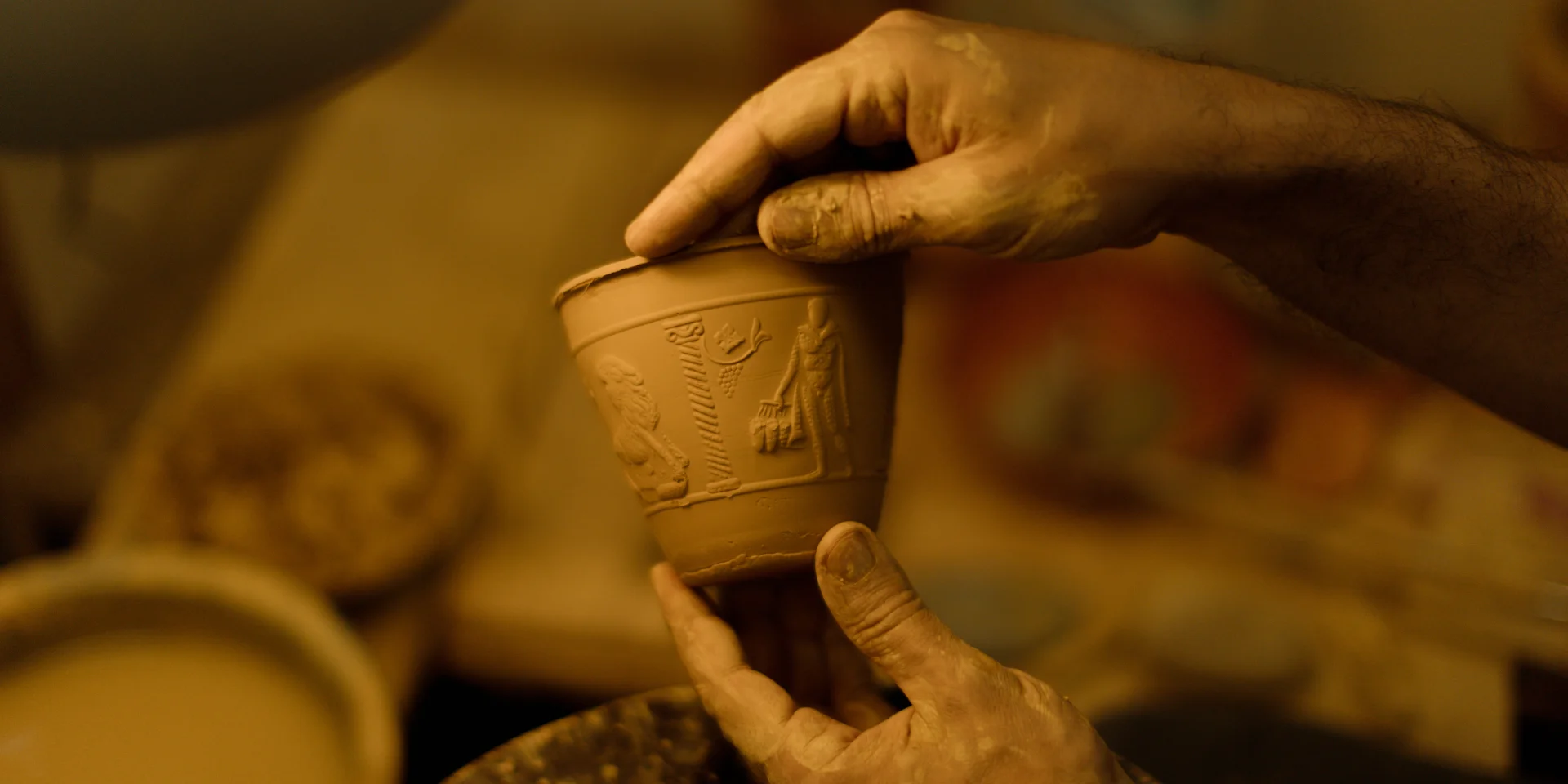
Among these creations, sigillated ceramics stand out, recognisable by their red or orange hue and relief decoration. These pieces, decorated with mythological or floral scenes, bore the names of their creators, testifying to the importance of the artistic signature at the time: more than 1,200 names of potters have been listed. Lezoux sigillia, a highly prized and fairly luxurious tableware, was exported throughout the Roman Empire, from Great Britain to Poland, thanks to a well-established distribution network. A visit to the Musée départemental de la Céramique in Lezoux will reveal some unique pieces from this period. However, with the end of Antiquity and the social upheavals that accompanied it, ceramics production declined, without ever dying out completely. Traces of ceramic production survive from the VIIᵉ to the IXᵉ century, and then into the Middle Ages, although less well known and of more local distribution.
In the XIXᵉ century, Lezoux and the surrounding area were teeming with small factories and itinerant craftsmen, perpetuating the pottery tradition. Recognising Lezoux’s historic importance in the art of ceramics, in 2007 the Conseil Départemental du Puy-de-Dôme opened a Musée départemental de la Céramique, located in the former Bompard factory, an emblematic site for this tradition. The museum tells the story of the region’s ceramics industry, spanning centuries of expertise and innovation.